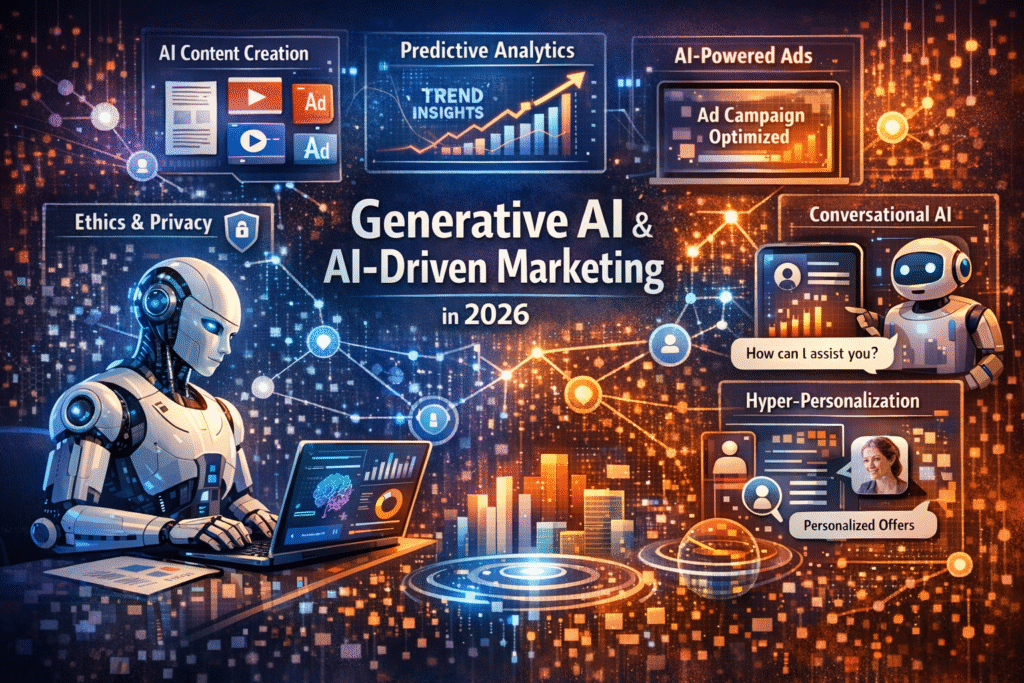
Generative AI and AI-driven marketing have become the defining forces shaping how brands plan, execute, and optimize their digital strategies in 2026, fundamentally transforming marketing from a largely reactive discipline into a predictive, adaptive, and deeply personalized engine for growth. At its core, generative AI refers to advanced models capable of creating human-like text, images, videos, audio, and even code, and in marketing this capability has moved far beyond simple automation into strategic decision-making and creative collaboration. Marketers now use AI to generate high-quality blog posts, social media captions, ad creatives, email campaigns, landing pages, product descriptions, and video scripts at scale, dramatically reducing production time while maintaining consistency across channels. However, the real power of AI-driven marketing lies not just in content creation but in its ability to analyze massive volumes of data in real time, uncover patterns invisible to humans, and turn those insights into immediate action. AI systems can study customer behavior across websites, apps, emails, social platforms, and ads, then dynamically adjust messaging, offers, formats, and timing for each individual user, enabling hyper-personalization at a level that was previously impossible. In 2026, personalization is no longer limited to using a customer’s name in an email; it involves AI predicting intent, emotional state, and purchase readiness, and then delivering the most relevant content or offer at the exact right moment. Predictive analytics powered by AI helps marketers forecast trends, identify high-value customers, anticipate churn, and optimize budgets with greater accuracy, ensuring marketing spend is focused where it delivers the highest return. AI-driven ad platforms now automate media buying, bidding, and creative testing, continuously learning which combinations of visuals, copy, audiences, and placements perform best, and reallocating budgets in real time without human intervention. This has shifted the role of marketers from manual execution to strategic oversight, creative direction, and ethical governance of AI systems. Another major shift driven by generative AI is the evolution of search and discovery, where brands must optimize not only for traditional search engines but also for AI-powered answer engines and conversational interfaces, a practice often referred to as Generative Engine Optimization (GEO). In this environment, visibility depends on being trusted, authoritative, and contextually relevant, as AI systems synthesize information from multiple sources to generate answers rather than simply ranking links. AI-driven marketing also extends into customer experience through intelligent chatbots and virtual assistants that provide instant, human-like support 24/7, guide users through complex purchase decisions, and even upsell or cross-sell based on real-time context. These systems learn continuously from interactions, improving accuracy and empathy over time, which strengthens customer satisfaction and brand loyalty. At the same time, generative AI has enabled rapid experimentation and innovation, allowing marketers to test thousands of creative variations, messaging angles, and campaign structures at minimal cost, fostering a culture of data-driven creativity where ideas are validated by performance rather than intuition alone. Despite its immense potential, AI-driven marketing in 2026 also brings important challenges and responsibilities, particularly around data privacy, bias, transparency, and brand authenticity. As consumers become more aware of AI-generated content, trust depends on ethical data use, clear consent, and maintaining a genuine human brand voice rather than relying solely on automated outputs. Successful brands treat AI as a co-pilot rather than a replacement, combining machine efficiency with human creativity, emotional intelligence, and strategic judgment. Marketers must also develop new skills, including prompt engineering, AI literacy, data interpretation, and creative supervision, to fully leverage these tools while avoiding over-automation and generic messaging. In essence, generative AI and AI-driven marketing represent a shift from mass marketing to intelligent, adaptive, and experience-led engagement, where every interaction is informed by data, optimized by algorithms, and refined by human insight. Brands that embrace this transformation thoughtfully gain a powerful competitive advantage, delivering relevant, timely, and meaningful experiences at scale, while those that resist risk falling behind in a landscape where speed, personalization, and intelligence define success.